
The Controversy Behind Korea’s ECM Skin Booster Trend Leave a comment
A skin booster is a term used to describe treatments designed to rapidly improve overall skin quality.
In the past, traditional skincare products mainly worked on the surface—delivering moisture and nutrients to the outer layer of the skin. Skin boosters, however, are different. They are designed to deliver active ingredients directly into the dermis, the deeper layer of the skin where real regeneration happens.
These treatments are typically administered using mesotherapy devices, lasers, or systems like Potenza RF Microneedling System, allowing ingredients to penetrate far beyond what topical cosmetics can achieve. Because the epidermal barrier limits absorption, regular skincare often has low penetration efficiency. Skin boosters overcome this limitation, resulting in faster and more noticeable effects.
The Evolution of Skin Boosters in Korea
- 1st Generation
Started with highly diluted hyaluronic acid injections, primarily used to hydrate the skin and fill fine wrinkles. - 2nd Generation
Introduced regenerative ingredients like PDRN (salmon DNA), focusing on tissue repair and healing. - 3rd Generation
Expanded into complex “nutrient cocktails,” such as those inspired by Filorga NCTF, combining vitamins, amino acids, and minerals for comprehensive skin revitalization. - 4th Generation
Shifted toward more advanced regenerative technologies:- PN (polynucleotides)
- Exosomes (cell signaling messengers)
- Collagen-stimulating agents like plla, pcl collagen stimulator
All of these generations share a common concept: delivering hydration and nutrients into the skin from the outside.
The New Trend in Korea: ECM Skin Boosters
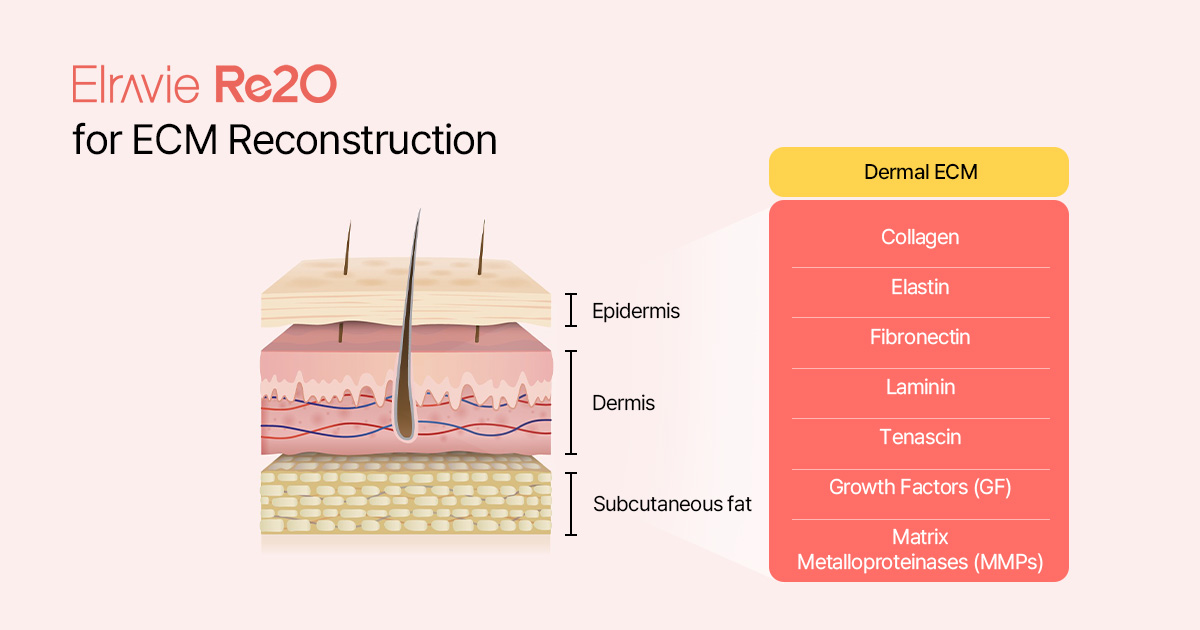
A new category has recently emerged in Korea—ECM (Extracellular Matrix) skin boosters. The extracellular matrix (ECM) is the structural foundation of the skin, made up of collagen, elastin, proteins, and glycoproteins. When this structure deteriorates, wrinkles form and skin elasticity declines.
From this perspective, skin aging is not just about aging cells—it’s about the breakdown of the environment those cells live in. ECM-based boosters aim to restore this structural environment itself. Think of it like renovating a house’s foundation, rather than simply repainting the walls.
Some early research, including studies from Severance Hospital Dermatology Department, suggests:
- Improved skin elasticity after ECM treatments
- Restoration of dermal structure
- Noticeable texture improvement after just one session
- Longer-lasting elasticity improvements after around three treatments
The Controversy
Despite the promising results, ECM skin boosters come with serious concerns. Unlike earlier generations (which are classified as medical devices and require clinical trials), ECM products have entered the market without sufficient human clinical validation.
The reason lies in classification: ECM is considered human tissue, not a conventional medical device. In many cases, ECM materials are derived from processed human dermis tissue donated. The tissue is treated (freeze-dried, sterilized, and powdered), then mixed with saline and delivery to skin with Meso treatment.
This raises several issues:
- Ethical concerns
Donated human tissue is intended for medical treatment and research—not high-cost cosmetic procedures. - Regulatory gaps
In the United States, strict guidelines (including those from U.S. Food and Drug Administration) limit the use of human tissue to minimize immune reactions.
Korea’s regulations, however, are still evolving in this area. - Safety concerns
Long-term safety and immune response risks are not yet fully understood.
Currently, several companies are already commercializing ECM boosters, with treatments priced around 600,000 to 900,000 KRW per session. Much of the ECM material is imported from North America, where it was originally developed for reconstructive purposes, such as treating burn patients—not for aesthetic use.
Final Thought
ECM skin boosters represent a fascinating shift—from simply adding ingredients to actually rebuilding the skin’s structural environment.
But even if the results appear promising, there’s an undeniable concern: these treatments are being adopted faster than the clinical evidence can support.
In short—it may work, but it’s still ahead of the science.


